Saturday, March 29, 2008

Saturday, March 29


Dendroica dominica - Yellow-Throated Warbler

Tuesday, February 26, 2008

Tuesday, February 26


Sitta pusilla - Brown-headed Nuthatch

Wednesday, February 20, 2008

Wednesday, February 20


Sitta canadensis - Red-breasted Nuthatch


Female and Male

The male checking out a hole in the old pine tree...

Tuesday, February 19, 2008

Tuesday, February 19


Junco hyemalis - Dark-eyed ("Slate-colored) Junco

The Junco 'sharing' with a Chipping Sparrow!!! Awwwwwwww!

Wednesday, February 6, 2008

Wednesday, February 6, 2008


Lanius ludovicianus - Loggerhead Shrike

Tuesday, January 15, 2008

Tuesday, January 15


Buteo lineatus - Red-shouldered Hawk


Regulus calendula - Ruby-crown Kinglet

Friday, January 4, 2008

Friday, January 4


Coragyps atratus - Black Vulture

Saturday, December 22, 2007

Friday, December 21


Sphyrapius varius - Yellow Bellied Sapsucker

Thursday, December 20, 2007

Thursday, December 20


Poecile carolinensis - Carolina Chickadee

Wednesday, December 19, 2007

Wednesday, December 19


Zonotrichia labicollis - White Throated Sparrow

Friday, December 7, 2007

Thus far

  1. Turdus migratorius - American Robin
  2. Geothlypis trichas - Common Yellowthroat (Warbler)
  3. Dendroica coronata - Yellow-rumped Warbler
  4. Spizella passerina - Chipping Sparrow
  5. Sayornis phoebe - Eastern Wood-Pewee
  6. Vireo flavifrons - Yellow throated Vireo
  7. Melospiza georgiana - Swamp Sparrow
  8. Buteo jamaicensis - Red-tailed Hawk
  9. Colaptes auratus - Northern Flicker
  10. Mycteria americana - Wood Stork
  11. Corvus ossifragus - Fish Crow
  12. Ceryle alcyon - Belted Kingfisher
  13. Buteo platypterus - Broad-winged Hawk
  14. Passer domesticus - House Sparrow
  15. Ardea alba - Great Egret
  16. Hirundo rustica - Barn Swallow
  17. Piranga rubra - Summer Tanager
  18. Tanager Passerina cyanea - Indigo Bunting
  19. Bubo virginianus - Great Horned Owl
  20. Passerculus sandwichensis - Savannah Sparrow
  21. Lophodytes cucullatus - Hooded Merganser
  22. Anhiga anhiga- Anhiga
  23. Polioptila caerulea - Blue-Grey Gnatcatcher
  24. Boaurus lentigingus - America Bittern
  25. Phalacrocorax auritus - Double Crested Cormorant
  26. Callipepla squamam - Northern Bobwhite
  27. Bubulcus ibis - Cattle Egret
  28. Euphagus carolinus - Rusty Blackbird
  29. Passer domesticus - House Sparrow
  30. Carpodacus purpureus - Purple Finch
  31. Aix sponsa - Wood Duck
  32. Beaolophus (Parus) bicolor - Tuffted Titmouse
  33. Plegadis ajaja - White Ibis
  34. Egretta caerulea - Little Blue Heron
  35. Ardea herodias - Great Blue Heron
  36. Streptopelia decaocto - Eurasian Collared-dove
  37. Melanerpes erythrocephalus - Red-headed Woodpecker
  38. Pipilo erythrophthalmus - Eastern (Rufous-sided) Towhee
  39. Empidonax flaviventris - Yellow-bellied Flycatcher \
  40. Anas platyrhynchos - Mallard Duck
  41. Mimus polyglottos - Northern Mockingbird
  42. Toxostoma rufum - Brown Thrasher
  43. Picoides Pubescens - Downy Woodpecker
  44. Cathartes aura - Turkey Vulture
  45. Coragyps atratus - Black Vulture
  46. Agelaius phoeniceus - Red-winged Blackbird
  47. Meleagris gallopavo -Eastern Wild Turkey
  48. Dryocopus pileatus - Pileated Woodpecker
  49. Molothrus ater - Brown-headed Cowbird
  50. Cyanocitta cristata - Blue Jay
  51. Zenaida macroura - Mourning Dove
  52. Tyrannus tyrannus - Eastern Kingbird
  53. Corvus brachyrhynchos - American Crow
  54. Archilochus colubris - Ruby-throated Hummingbird
  55. Cardinalis cardinalis - Northern Cardinal
  56. Branta canadensis - Canada Goose
  57. Charadrius vociferus - Killdeer
  58. Progne subis - Purple Martin

Thursday, December 6, 2007

Thursday, December 6


Turdus migratorius - American Robin


Geothlypis trichas - Common Yellowthroat (Warbler)

Tuesday, December 4, 2007

Tuesday, December 4


Dendroica coronata - Yellow-rumped Warbler

special thanks to Peregrinator from the BirdForum in helping to identify this Little Guy

Monday, December 3, 2007

Monday, December 3


Spizella passerina - Chipping Sparrow


Sayornis phoebe - Eastern Wood-Pewee


Vireo flavifrons - Yellow throated Vireo


Tuesday, November 27, 2007

Tuesday, November 27


Melospiza georgiana - Swamp Sparrow

Sunday, October 21, 2007

Sunday, October 21

While we were sitting on the back deck yesterday, something flew over and Sarah got a glimpse of the high soaring bird between the roof lines of the breezeway.

"That's a buzzard, isn't it?" I said.

"No, it's the wrong color!!!" Sarah replied.

I ran for the camera and extended the zoom to the full 300mm. He politely landed in one of the bare trees on the Lane and posed for his picture to be taken.

Buteo jamaicensis - Red-tailed Hawk

Thursday, October 11, 2007

Thursday, October 11

Colaptes auratus - Northern Flicker

Saturday, October 6, 2007

A breeding pair?


Titbits of Wood Stork facts:

Because of their specialized feeding behavior, wood storks forage most effectively in shallow-water areas with highly concentrated prey.

Wood storks use a variety of freshwater and estuarine wetlands for breeding, feeding, and roosting. Nests must be located in trees in standing water or on islands surrounded by water. Height of nests above the water ranges from 3-7 feet in small trees to over 66 feet in cypress trees.

During the nonbreeding season or while foraging, wood storks occur in a wide variety of wetland habitats. Typical foraging sites for the wood stork include freshwater marshes and stock ponds, shallow, seasonally flooded roadside or agricultural ditches, narrow tidal creeks or shallow tidal pools, managed impoundments, and depressions in cypress heads and swamp sloughs.

Friday, October 5, 2007

'Bout Time

It's been weeks months since we been able to add another bird to our list!

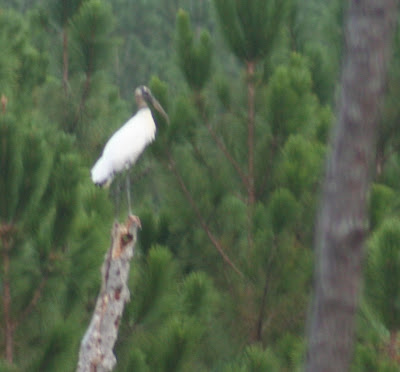
We had seen him a couple times before. He was always in flight away from us or too far away to get a good photo. However yesterday evening, he stayed perched on a remains of a old pine tree - allowing us to take several pictures. He remained contently on his post as we departed the Beaver Pond.


Mycteria americana - Wood Stork

Wood Storks have been on the Endangered Species List since 1984. In the early 1900's, there were more than 60,000 of these birds in the U.S. But habitat destruction, development, and pollution caused their population to dwindle to only 4,500 breeding pairs in the 1980's. Wood Storks are stabilizing and now have between 5,000 and 7,000 breeding pairs. The health and existence of the wood stork is a good way for us to measure the health of the wetlands where they live.

Tuesday, July 31, 2007

Dog Days

The time between the early of July and the middle of August is known as Dog Days.

South Georgian lore tells that song birds are mostly quiet during these hot and humid days. Many a trip to the Beaver Pond and around the trails in the woods yield nothing picture worthy.

We are waiting for the cooler temperatures and the return of the winter birds to the region.